


Dig it, they will come.


I’ve always been passionate about water and the creatures that live in it - be they reptiles, crustaceans, cephalopods or fish. In every film I made with Vicky we always managed to include a fish - even when making a film about fig trees or a film about elephants.
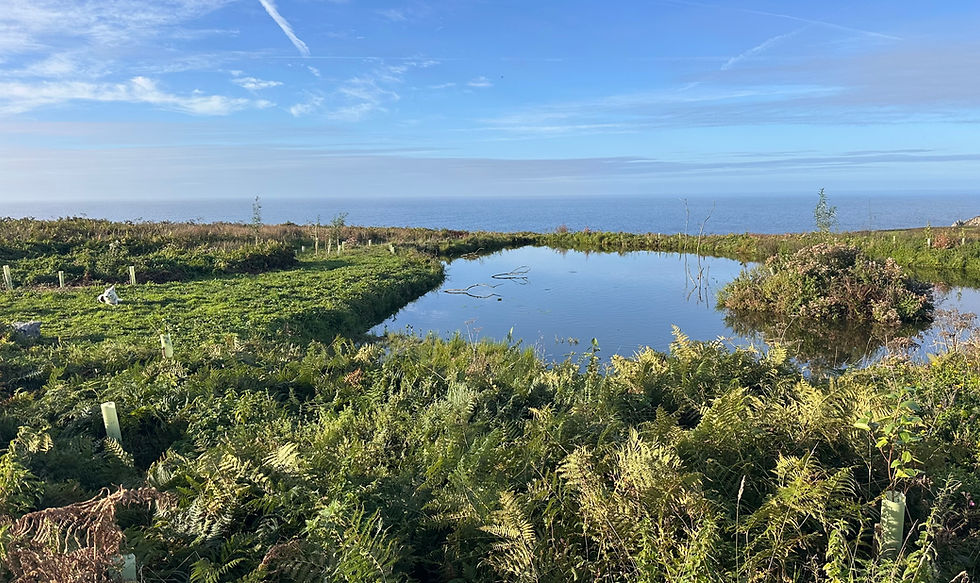
It is not surprising then that pond creation was always high on my list for Rose-an-Hale. Besides, nothing boosts biodiversity faster than digging a pond - even if you don’t actively plant or stock it, life arrives by itself.
To begin with it flies in, later it is blown - sometimes it slithers, hops or jumps.
This succession of transport methods was exactly what we witnessed at the big pond we dug in April.
It was dug in naturally damp ground, dominated by Hemlock Water Dropwort - a plant that gets a lot of bad press these days as it is highly toxic. It’s a wonderful food source for pollinators though and more than deserving of its place in the reserve. Once dug, we diverted a small leat into the pond and even though it filled slowly, we didn’t need to line it and within days the area of open water stretched 40m from one bank to the other.
The first residents to arrive were water striders - they flew in within 24 hrs to feed on tiny insects that would be blown in or trapped by the surface tension. They were followed very quickly by water boatmen and water beetles.
A day or two later a pair of Canada geese arrived. They fed in the surrounding fields and used the pond as a refuge - somewhere they might rest in safety at night. They didn’t stay more than a few weeks, but hopefully they’ll be back in the spring and might one day nest on the small island we made for that purpose.
After them came a pair of moorhens, who did nest. To begin with they were very shy - for weeks I saw nothing but heard one occasionally call - then, one evening sitting on the stone bench with a friend, I held my breath as a female moorhen led a line of four black downy chicks off the island, over to the bank and up into the bracken.
We’ve helped, of course.
I’ve not driven anywhere this summer without a car full of buckets and nets. We’ve pilfered the ponds on the moors for water lilies and the delicate yellow Fringe - a tiny native water lily that, in time, should grow around the margins. Deep-water Brandy Bottle lilies followed, together with reeds, bullrushes and a mat-forming dwarf sedge that should help stabilise the banks and prevent them being eroded by the winter gales. Along with them, I hope, will have come snail eggs and invertebrates.
Dragons and Damsels soon followed and early in July, a Blue Emperor Dragonfly arrived and patrolled the western bank, quartering up and down for its insect prey. Two days later we saw it laying eggs - hopefully that is the start of a new population.

We put in old ash branches for birds to perch on. We tied them to stakes hammered into the bottom of the pond. Many succumbed the first westerly gale but those that remain are popular with swallows.
Later in the summer we added fish - rudd, carp and tench and a week or two later we had a little egret patrolling the bank. Its been wonderful to see how each species that has established itself, in turn, attracts more. The island grew a good stand of hemp agrimony which attracted house sparrows to feed and after them came a sparrow hawk. We’ve had the occasional snipe and green sandpiper - and it won’t be long before the local peregrine checks the pond out for prey.
I think the greatest surprise though has been the people that have come - when I thought about creating the ponds I imagined that it would be only wildlife that visited. How wrong I was - for it is just as popular with people, who come to sit on the stone bench and look out across the pond.
Neighbours from the local hamlet walk down in the evening and visitors staying nearby bring a glass of wine and watch the swallows and martins gathering and then swooping in to drink.
A barmaid from the local pub walks down to spend her break there; children release baby toads there they’ve brought from their grandparents’ garden.
One lovely couple I met said that they had visited 3 times in two weeks with their son and one of those visits was to return for a birthday celebration.
It makes me smile because I know how important the enjoyment of others would have been to Vicky.
Just as she made films to share her passion for the natural world, so sharing the pond with others would have given her enormous pleasure.
It is a pleasure that I am beginning to recognise.


Jambo Sana Mark. Lovely to read all this, Asante.
I am in the process of planning a pond at our place in the south west France right now as we are installing a rain water tank under a deck and the pond will take the overflow. My question is what time of year did you dig your ponds? Does it matter? And how can I make it naturally water tight (ish) without using a liner and considering my soil is alluvial?
Salaams to you from Georgina and Bart.
Mate, I'm so happy to see you writing again despite the heartbreaking circumstances. I will let you know when next I am back in Cornwall and would love to visit if our schedules coincide.
Hi Mark,
Wonderful to see our favorite pond.
It is a pleasure just to sit there take a moment and enjoy nature.
And you made this happen.
Thank you!
It is great to see Vicky and your special place.
It is our special place as well.
Sinead & Felix