


The Remarkable Painted Lady

Updated: Jul 17

It sounds like a title that should be emblazoned on a sign outside a Victorian circus tent, but our painted lady is a beautiful earth-toned, striped butterfly named Vanessa - Vanessa cardui - literally ‘Vanessa of the thistles’.
We’ve all heard of the monarch butterfly and its migration the length of North America, but who would have thought we have a similar butterfly migration here in west Cornwall? A butterfly whose round-trip is almost double that of the monarch's - covering up to ten thousand miles.
It’s all the more interesting as it wasn’t discovered until recently - in 2018.
Like many others, I learnt that painted ladies were warm-weather visitors from North Africa that occasionally turned up in number but which languished in the autumn and if any persisted, then they succumbed to the first frost.
The reality is very different - we've known for decades that they moved north in summer, but researchers in the UK and Spain recently discovered that they make a return journey south in the autumn. The reason we thought they died was that none were ever seen returning south - until zoologists from York tracked them with radar and proved that they were flying high - at 500-1000m above the ground.
Their migration was confirmed by an elegant international study that looked at the signature of chemical isotopes that were locked up in the butterflies’ wings - it was a form of ‘chemical fingerprinting’ that pinpointed where they had grown up as caterpillars.
It concluded that some autumn butterflies from northern Europe fly all the way across the Mediterranean and Sahara but that for most there is a “leapfrog migration,” where it might take up to six generations to do the round-trip.

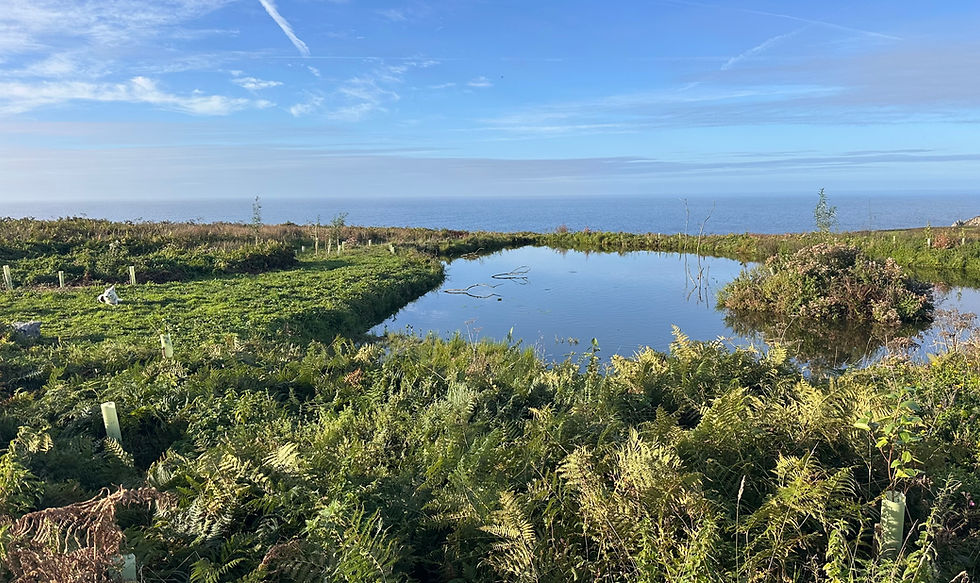
It all starts with a tiny egg, laid on the underside of the leaf of a food plant - at Rose-an-Hale that’s commonly a marsh thistle. The painted lady’s caterpillars feed on thistles, mallows and nettles so the butterfly’s migration follows the emergence of these plants - from winter in the Sahel to summer in the Arctic. In a way their lives are lived in search of an endless summer, flying to wherever thistles emerge next.

The adults aren’t constantly on the wing - when one first emerges from its pupa, it is immature. It might take a week to become sexually mature, so in that time, the butterflies move. Then, when they find a suitable area for laying their eggs and for their caterpillars to grow, they become more sedentary - it’s why we first see them here at Rose-an-Hale when the marsh thistles start to grow in May. As the season progresses the early colonisers are replaced by much smaller individuals - this is because food for their caterpillars becomes scarcer as summer progresses. Less food means smaller caterpillars and results in butterflies which might be only half the size of the early arrivals.
Within a few weeks of their arrival, their caterpillars can be seen - evidenced by the silk tents they weave on thistles and nettles. Unlike the small tortoise shell caterpillars that we commonly see clumped together on nettles, the painted lady’s are solitary. Each weaves together a pair of leaves with silk, where it can feed in safety out of sight of predatory birds.

At Rose-an-Hale, the silk tent also protects it from wind-blown salt spray - which would otherwise quickly dry out and kill such a soft- bodied caterpillar. Inside its tent, it grows quickly and once it’s reached 3-4 cm it is ready to pupate. A week or two later the shiny chrysalis splits to reveal an adult painted lady with crumpled wings. Once her wings are pumped up and dried out, she’ll take to the air. If it’s early in the season she’ll fly north, if it’s towards the end of the summer, then it’s south.
She’ll never return to Rose-an-Hale but her descendants will, timing their arrival to coincide with the flush of marsh thistle growth in the reserve's wetlands early next May.


Mark just read all three posts- wonderful in the true sense of the word. Thank you
Wonderful Mark look forward to following
Enchanting ! Thank you .... Thank you Thank you