


Summer visitors, sun and sunfish


At Rose-an-Hale we’ve had a succession of heatwaves this summer and, with them, very little wind. Any there was, tended to come from the east. It’s all change now though - the southwesterlies are back, bringing autumnal swells. It is the wind though that will bring Atlantic ocean visitors to the cove. Late summer / early autumn is a wonderful time here. The water is still warm and we are on the cusp of seasonal change - which is always exciting.
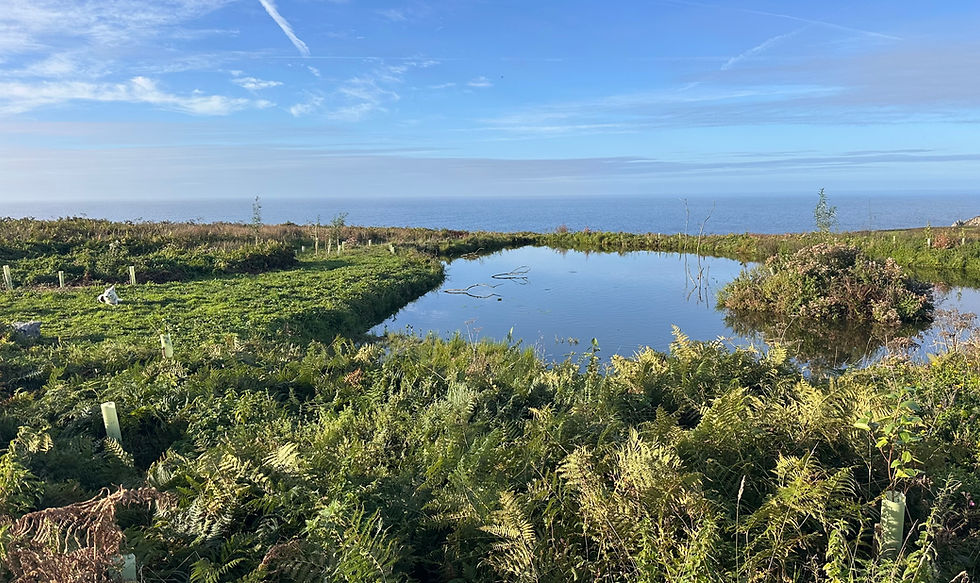
Although the reserve has stayed green and the ponds remained full, this summer’s heatwaves have started to bring home to many of us, just how fast our climate is changing. The heat has burnt many of the clumps of thrift perched on the cliffs above the cove. A good number will survive and establish themselves again next season, but its alarming to see the cliffs so scorched. It is underwater though, and largely out of sight, that the effects of climate change are most profound.
Mackerel were once commonplace, the most numerous fish in the cove - today they are some of the rarest. It’s the same with basking sharks. Thirty years ago on a calm April afternoon we counted 25 basking sharks in the cove.

Their dark dorsal fins projected half a metre from the surface and behind each the water spun into vortices caused by the lazy sculling of its tail. Some came close - only a few metres from the rocks. Out in the tidal race one breached - its entire body leaving the water. It crashed down in flurry of spray - and the sound of the splash reached us a second later.
Their arrival used to signal the beginning of summer, but this year I’ve not seen one, and where we used to catch half a bucket of mackerel in just a few minutes, this summer, I’ve caught just two.
The reason for the disappearance of both is the northwards movement of their prey - a tiny copepod no bigger than a sesame seed. It’s a cold water species (Calanus finmarchius), a member of the zooplankton - so rich in lipids, that fat can make up to half of its body weight. It’s becoming too warm for them here now, so the tiny copepods are migrating towards the arctic - followed by all those who would eat them.
Here at Rose-an-Hale on the west coast of Cornwall, we sit at the boundary of southern and northern ( Lusitanian vs Boreal) marine biogeographic regions. Some species, like cod and haddock are at their southern limit, others like octopus and grey trigger-fish are at their northern - so a small change in temperature can have a huge impact on their numbers and distribution.
We’ve seen that this summer with the bloom in common octopus. Common octopus were never as common here as they were in the Mediterranean but over the last two summers that has changed. They’ve moved north into Cornish waters and hundreds of tonnes have been landed by fishermen at Newlyn this year. Their impact on lobster and crab populations has been devastating - it is just one example of how the arrival of a warm water species can have such an impact on the ecosystem.
Late summer is the best time for our aquatic visitors. Both By-the-Wind sailors and Portuguese Men O' War blow in after prolonged southwesterly winds. The wind is their friend - it pushes them up from the mid Atlantic. Wind power means that they’ve not evolved the need to move by themselves. But while the wind offers free transport it can also dry them out. By-the-Wind sailors avoid this by creating a hard transparent ‘sail’ made of chitin. They come in two forms - their sails are either right or left handed. It means that, in a breeze, they sail off in different directions, which ensures that the whole population doesn’t get wrecked. Around Cornwall we sometimes see thousand upon thousand washed up on the beach, but we can be assured that it’s not disaster for the species, for just as many will have been blown offshore.

A Portuguese Man O’ War solves the problem of desiccation by occasionally flopping from side to side to dunk its float to keep it wet.
Both the Portuguese Man O’War and the By-the-wind sailor are colonies, made up of tiny polyps - each with a different and specialised function that that together make up the whole.

With the warm water too come sunfish. They are strangely shaped fish, laterally flattened that can often be seen at the surface, their dorsal fin flopping from one side to another.

Spending time at surface keeps them warmer than swimming at depth and it often attracts gulls which gather around to clean them of parasites. They feed on jellyfish - particularly compass and moon jellyfish that are our most common summer species.

We generally see youngsters, but at up to c 20 kg they are still sizeable fish. The largest I've seen here is one of almost 2m - mounted on a wall inside the castle on St Michael’s Mount. It is stuffed and dried out, but it must have weighted close to 500kg when it was captured almost two hundred years ago.
So what of the future? We’ve seen a huge rise in southern species entering our waters. Bluefin tuna have moved their range north in the last 15 years - and they are arriving in our waters earlier each summer. Besides man, adult bluefin don’t have many predators other than orca and great white sharks - both of which hunt them in the Mediterranean and the Bay of Biscay.
Like basking sharks and mackerel they too will follow their prey north, so it shouldn't be long before we get a confirmed sighting of a great white in Cornish waters!


I found you! What a pleasure meeting you , your son and - and yes your dog especially- on the trail yesterday. I am enjoying your blog. Evening reading after having just finished Pendeen-Sennen section of the Coastal path.