


The beginning

Updated: May 2
April 2026

It's been over a year now since Vicky died - looking out over the cliffs that she loved.
In that time, we've held two 'celebrations' for her life - one here and one in Kenya. This winter though I started to feel that a lasting, 'living memorial' would both honour her approach to life and celebrate the natural world that inspired her. It would be something that would grow - perhaps in size, but more importantly in biodiversity. There was no moment of decision but I found myself talking about it to people and the more I talked and thought, the more an idea began to take shape.
A reserve for wildlife where she lived and where she walked every day. To share a place she loved deeply with others.
I'd seen how the wooden benches I made for Vicky on the track from the cove had been appreciated by people walking up from the coast path. As they had been for Vicky, they were a place to stop awhile, draw breath and look out over Rose-an-Hale cove. I planned a couple more, in stone, beside ponds.
To increase biodiversity, some intervention would be necessary - but it would be slow and evolving - planned after decades of observation.
I've always wondered what the cliffs and valleys would have looked like two thousand years ago - probably they were wooded with stunted, wind-twisted trees. With this in mind, in the autumn I planted a hillside with sessile oak, wild service trees, spindle and alder buckthorn. They are all native species that are found in the ancient Dizzard wood in north Cornwall. Could they survive here and perhaps grow into something similar but on a much smaller scale? There was only one way to find out.
I included alder buckthorn as it is food for the caterpillars of brimstone butterflies - how wonderful it would be to see them here.
And so it began. I don't know where it will end but already we've a net biodiversity gain as we are seeing species that have not been recorded here before.
Vicky would have loved to see people enjoying it - sharing the wonders and stories of the natural world was what drove her. So, we need to start somewhere and why not in March 2026 - a time of renewal and hope for the year ahead.
Spring always comes late here on the cliffs and a succession of strong cold northwesterly winds did nothing to help this year. When the winds and swells were at their strongest, a number of grey seals from nearby Porthmeor took shelter, for a week, in the western corner of Treen cove. Its the one place they can sleep and get some respite when its very rough.
The first swallows were seen in mid April, drinking at the newly dug ‘big pond’ followed by the arrival of the first grasshopper warbler on 14th April. A few days later there were 3 males singing - hopefully they will establish territories and nest this season. Last year they sang for a few days and then moved on. Sedge warblers, Willow warblers, chiffchaffs and greater whitethroats moved in during the same week. The first cuckoo was heard singing from Boswednack mire on the 19th.
It has been cold and very few butterflies have been seen yet - so far just a Painted Lady, Red Admiral and Meadow Brown.
Painted ladies are remarkable butterflies - their migration brings them to Rose-an-Hale from Africa (like many of the birds) but the round trip might take them six generations to achieve. The food source for their caterpillars is newly emerged thistles so their journey can be described as one 'in search of a perpetual spring'.
The corner pond that was dug in March 2025 has become well established with large numbers of toad tadpoles this year and a good population of three-spined sticklebacks.
Herons have been seen fishing and, incredibly, a dog otter visited the pond in mid-March. His visit was captured by a camera-trap. In subsequent days a female with 2 cubs was seen fishing in another pond - the first time otters have been recorded here in over 30 years. It is a testament to the new ponds - 'Dig it and they will come'.
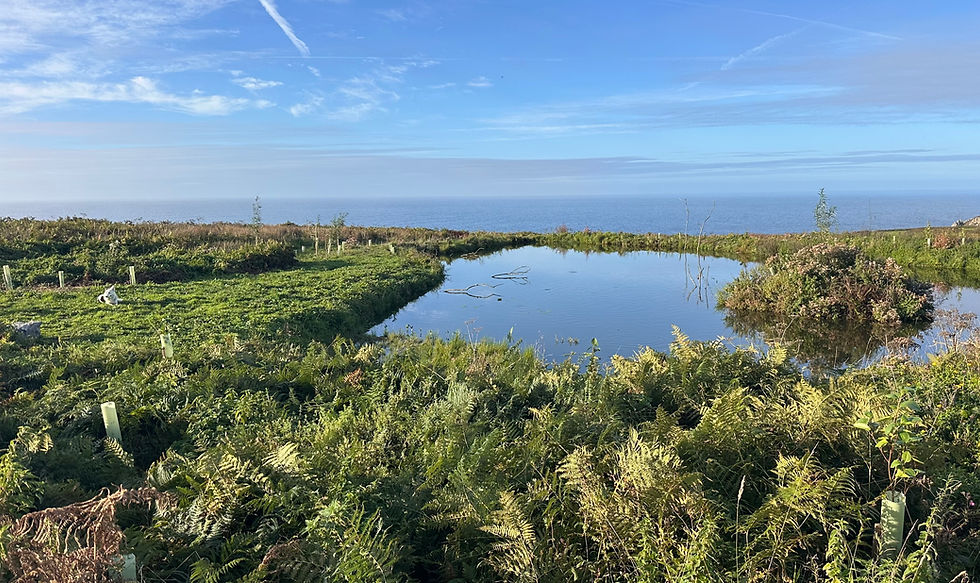
Two more ponds were finished early in April - the larger one, on the rough ground opposite Boswednack mire, filled to half-way within a few days, but there it has stayed.
It might take next winter’s rain to fill completely. Around it we planted willow, sessile oak, alder and elder to help stabilise the banks. Already Canada geese have visited and we put in a small island in the hope of attracting waterfowl to nest there in the future.


Beautiful post Mark. I’d love to see when next in Cornwall.
Magnificent! So moving and beautiful... Thank you 💚